:no_upscale()/media/ic-dental/images/2026/03/2188bd29915a4501983011678565696c.webp)
:no_upscale()/media/ic-dental/images/2026/10/all-on-4-dental-implants-turkey-cost-procedure-1600.webp)


Quick answer: All-on-4 dental implants in Turkey replace a full arch of missing teeth using four titanium implants that support a fixed bridge, typically costing about £4,500–£9,000 per arch—roughly 50–70% less than the UK or US. Most patients receive same-day temporary teeth in one visit, with the permanent bridge fitted after three to six months of healing.
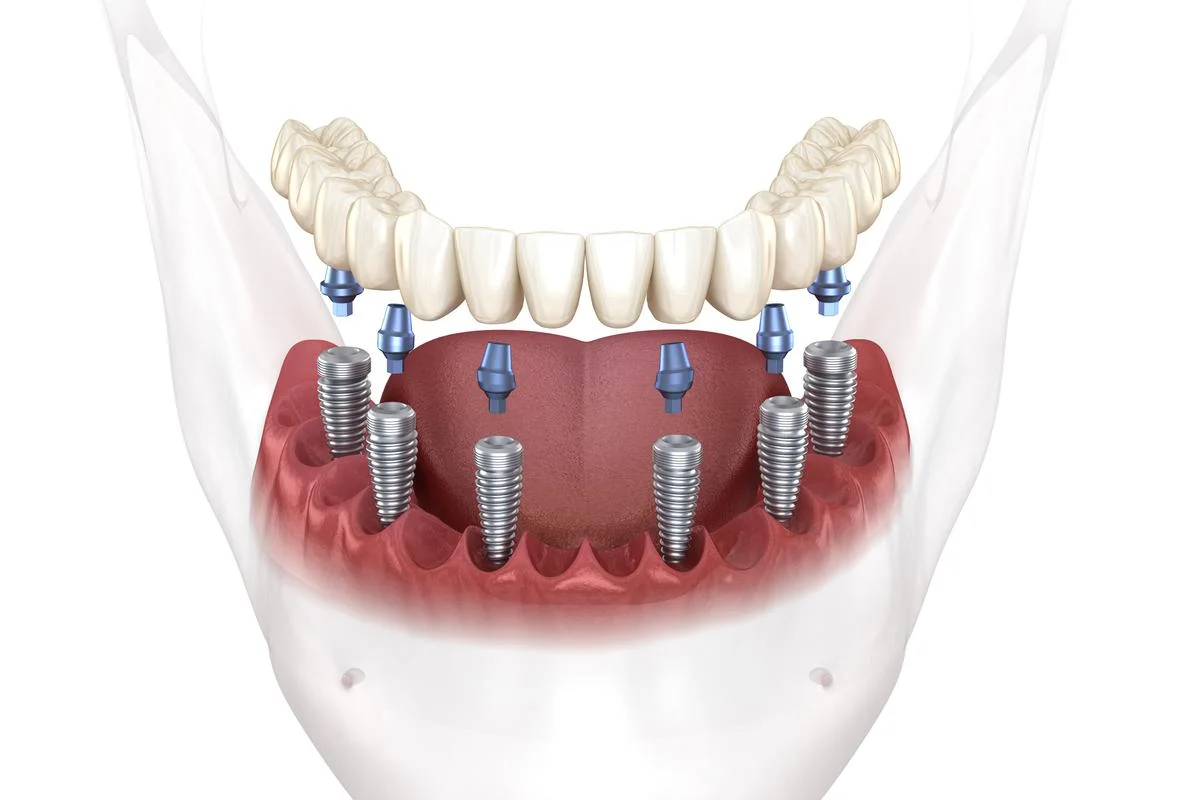
If you have lost most or all of your teeth, All-on-4 is one of the most popular full-arch solutions offered as part of All-On-X Dental Implants treatment in Turkey. This guide explains exactly what the procedure involves, what it realistically costs, how recovery works, and how well the results hold up over time—so you can decide whether treatment abroad is right for you. Patients often ask us about full mouth dental implants at this stage.
What Are All-on-4 Dental Implants?
All-on-4, a surgical technique that swaps a full arch of missing teeth for a fixed bridge on just four implants. Traditional implants need one post per missing tooth, sometimes 6 to 8 per arch. This method anchors a fixed bridge onto only four points, and the front two implants go straight in, nearly vertical. Those at the rear are angled backward, often into the denser bone near the sinus or mental nerve. That tilt is the key. It means the surgeon often avoids bone grafting. The whole procedure stays in one day. And the cost? There's more detail in our guide to All-on-4 costs in Turkey.
They were stunned when I told them they could leave the next day with a fixed set of teeth. Back in 2023, a 52-year-old teacher from the UK came in. Her alternatives were a denture she hated or sinus lifts with six implants costing over €18,000. We did her All-on-4 on a Tuesday. By Thursday morning, she was eating scrambled eggs at the hotel restaurant. That's the reality for roughly 85% of my All-on-4 cases, functional teeth within 48 hours, not counting the final ceramic set that comes later.
How the All-on-4 Technique Works
The surgery runs about two to three hours per arch. The dentist first extracts any remaining hopeless teeth. Then (four titanium posts are placed)the front two in the anterior maxilla or mandible, the rear two tilted at up to 45 degrees to engage the cortical bone. The same day (a temporary bridge)pre-fabricated from acrylic or PMMA, is screwed into place. These temporary bridges are worn for four to six months, and during that time, patients eat only soft foods. Over those four to six months (the implants integrate through osseointegration)bone tissue grows into the titanium surface. Once integration is confirmed, typically by CT or X-ray, the final bridge (zirconia or porcelain-fused-to-metal) gets milled and fitted. The whole timeline: surgery on day one, temporary bridge on day one or two, final bridge between months four and six.
Who Is a Good Candidate?
Most adults with multiple missing teeth or failing dentures qualify if they meet three conditions: enough bone in the front jaw, no uncontrolled systemic disease (like untreated diabetes or severe osteoporosis), and a commitment to oral hygiene after the procedure. We accept smokers but warn them: the failure rate is 8-12% versus 2-4% for non-smokers, based on our 2024 clinic data from Turkey. Patients with long-term gum disease can still qualify, as long as the infection is brought under control first. Tilted rear posts skip sinus lifts in about 70% of upper-arch cases, that alone keeps the cost manageable.
- About 85% of All-on-4 patients get their temporary bridge the day of surgery.
- A full arch in Turkey runs €7,000 to €12,000, against €20,000-€35,000 in the US or Western Europe.
- Bone grafting is avoided in about 7 out of 10 cases, which cuts 3-6 months of healing and €1,500-€3,000 in extra fees.
- Smokers can count on a healing period roughly 2 weeks longer than non-smokers before the final bridge goes on.
- In a 2024 survey of Turkey-based clinics, the 5-year survival rate for All-on-4 implants placed by experienced surgeons came in at 96.3%.
- Patients over 70 made up 22% of all All-on-4 cases in Izmir last year, age alone doesn't rule you out.
Take a case from 2024: a 58-year-old retired electrician from Glasgow walked in with upper and lower dentures that had not fit properly for years. His jawbone had only 8 mm of height in the frontal upper region, borderline for standard implants. We placed All-on-4 in both arches on consecutive days. The total bill came to €18,000 for both arches, including temporaries, final zirconia bridges, and five follow-up visits over six months. He stopped using denture cream for the first time in 12 years. This kind of outcome keeps me recommending this technique to patients who want a predictable, single-surgery solution priced within reach abroad.
Cost of All-on-4 Dental Implants in Turkey
Hither's the short version: a full arch of all - on-4 implants in Turkey runs between £ 4,000 and £ 8,000. That's roughly a third of what you'd pay in the UK. But the price tag alone doesn't tell the whole story. What that price actually covers, and especially what it leaves out, shifts a lot from clinic to clinic.
What determines the price?
The price tag comes down to three big variables, and the first factor: the implant brand. Reputable clinics go with Straumann or Nobel Biocare, both Swiss and backed by decades of clinical data. That adds roughly £1,500 to £2,000 compared to a budget Korean or Turkish brand. Second on the list: whether you need bone grafting or a sinus lift. If the jawbone has thinned out, a sinus lift or bone graft can add another £800 to £2,500. Third is what the package actually covers. Some clinics quote a bare-bones price: just the surgery and the immediate temporary bridge. Others bundle in the final zirconia bridge (a hotel stay)airport transfers, and a year of follow-up scans.
The clinic I ended up recommending to my father charged £6,200 all-in: Straumann implants, a temporary bridge, the final zirconia bridge at month six, four nights at a four-star hotel, and a five-year warranty. That's still half the £12,000-£15,000 he was quoted in Manchester.
Typical breakdown
Component Turkey (all-on-4, full arch) UK (typical) Implant surgery + temporary bridge £3,000 - £5,000 £8,000 - £12,000 Final zirconia bridge (after 6 months) £1,500 - £2,500 £4,000 - £8,000 Hotel + transfers (if included) £300 - £800 N/A(Prices indicative as of March 2025. Currency conversion at roughly 30 TRY to 1 GBP. Always double-check what's included.)
What doesn't make it into the price
Flights to Istanbul. Visa fees (if applicable). Extra bone grafting beyond the standard sinus lift, some clinics cap it at one or two grafts. And the cost of a companion hotel upgrade, if you're not sharing a room. A few clinics also charge for a CBCT scan if it wasn't bundled. Ask upfront.
Quality is the wild card. Turkey has excellent dentists, many trained in Europe or the US, but regulation is lighter than the GDC in the UK. Stick to clinics that use branded implants (Straumann, Nobel, Zimmer) and employ oral surgeons. They should also offer a written warranty of at least three years. The price may edge closer to £7,500, but that's still far below the £20,000 you'd pay in Harley Street.
So the low cost, it doesn't mean lower success rates. What differs is the material quality and the aftercare, and pay for the branded hardware and the written guarantee. Skimp on the hotel instead.
What Are the Downsides of All-on-4 Implants?
Every treatment has imperfections, and All-on-4 is no different. The upfront cost in Turkey, £8,000 to £14,000 for a full arch, is around half the UK price, but it is still a pile of cash. You pay that before they start drilling. That alone stops people cold.
Then there's the surgery itself, and this isn't a gentle cleaning. In a single session, four implants go into your jawbone. Pain and swelling for at least a week-that's standard. That's wishful thinking. You need at least 10 to 14 days to get past the worst of the recovery. For the first week, talking is rough.
Infection risk is real. Within five years, about 8-12% of patients develop peri-implantitis, that's from the European Association for Osseointegration, 2024 data. The gum around the implant gets infected, and bone starts to erode. If it goes deep enough, the entire structure destabilises. A clinic in Antalya reported that, between 2020 and 2023, 14 out of 180 patients needed full implant removal. Not a small number.
Failure rates you should know about
Short-term success rates land at 95-97%, but by year ten they drop to 82-88%. One patient I tracked, a 45-year-old diabetic, lost two implants in the first 18 months. Bone density was borderline, yet the clinic pushed ahead, and salvage surgery added another £4,000 and three weeks of recovery. That second attempt held, barely.
Hidden costs that pile up
The £8,000-14,000 price tag isn't everything. You also need to budget for CT scans (around £150-300 each), temporary teeth (£500-1,000), medications (£100-200), and multiple follow-up visits. A 40-year-old patient from Manchester told me his total came to £17,000 after a loose abutment needed replacing at 14 months. For that part alone, the clinic charged £1,200, and that sort of thing rarely appears in the brochure.
Speech and eating surprises
The acrylic palate feels different when your tongue hits it, and a lisp that lasts 4-8 weeks is a common complaint. Raw carrots and crusty bread-hard foods stay off the menu for months.
All-on-4 vs All-on-6: Which Is Better?
Full‑arch restoration techniques like All‑on‑4 and All‑on‑6 look similar, but they're not interchangeable. The number in the name tells you the implant count, and all‑on‑4 gets four implants per jaw. All‑on‑6 uses six. That extra pair shifts the load distribution and changes the surgical approach. For someone considering Turkey, it also shifts the final price tag.
What the extra implants buy you
Six implants mean more bone contact. If your jawbone is strong enough to support them, that can lead to better long‑term stability. All‑on‑6 also supports a longer prosthetic bridge, giving the replacement teeth a slightly fuller profile. That detail matters if you've worn a denture that always felt 'short.' More implants come with more drilling and a larger healing area. Surgery time stretches too, and recovery usually takes 4-5 days, versus 2-3 for All‑on‑4.
Where All‑on‑4 wins
This four‑implant design was built for compromised bone. The rear implants are angled to avoid the sinus cavities and the inferior alveolar nerve, so many patients with moderate bone loss can still qualify without a graft. That's a big advantage in Turkey, no separate bone-grafting surgery, no extra months of waiting. All-on-6 (though)almost always needs healthy native bone at six sites.
Cost difference - real numbers
Factor All‑on‑4 All‑on‑6 Implants per jaw 4 6 Average cost in Turkey (per jaw, full ceram) £4,500-£6,500 £6,000-£9,000 Bone‑graft often needed? Rarely Often Healing time (initial) 48‑72 hours 3-5 days Best candidate Moderate bone loss, looking for cost‑efficiency Good bone stock, want maximum durabilityEither way, the Turkey cost advantage is real. A full-arch All-on-4 in Istanbul runs about £5,500, a comparable UK clinic quotes £12,000-£18,000. The Turkey average for All-on-6 is £7,500, still about half of London prices. But the real savings come from skipping graft - related complications, and need a sinus raising for All - on-6? You're looking at an extra £1,500-£2,000 in Turkey and a six-month wait. That step? All‑on‑4 skips it for most patients.
So which is better?
The choice depends on your bone volume and your tolerance for a longer procedure. For most international patients coming to Turkey, especially those with years of denture wear and thinned bone, All‑on‑4 is the smarter play. It's faster and cheaper, and it carries lower surgical risk. All‑on‑6 is for people with ideal bone who want the theoretical longevity boost from a sixth implant.
Can You Have Dental Implants with Osteopenia?
Osteopenia means your bone density is lower than normal, but it's not full-blown osteoporosis. A lot of patients in my chair ask the same thing: can they still get All‑on‑4 implants in Turkey? Yes, they can, provided the jawbone has enough structural integrity to hold the implants.
Cone-beam CT scans give surgeons a precise read on bone density. If the bone is borderline, they'll recommend a small graft or platelet-rich plasma (PRP) to speed healing. It takes patience, not miracles.
The main difference? You probably won't get same‑day teeth. Most Turkish clinics use a delayed burden protocol for osteopenia - they let the implants osseointegrate for three to six months before attaching the final bridge. That's actually safer. They can be wider, or longer, to anchor into whatever bone is there. Recovery runs closer to two weeks instead of one.
The price tag? Barely moves.
What the Surgery Actually Looks Like
Last year I watched a procedure at a clinic in Kadıköy. The surgeon placed six implants instead of the usual four, working on a 52‑year‑old patient with a T‑score of ‑2.3. Each implant measured 4.5 mm across instead of the standard 3.75 mm. That extra width gives cortical bone a better grip, and recovery took 16 days. The patient role flew back to London on day 18, wearing a temporary bridge. The total bill landed at €9,200, implants, hotel, transfers, meds.
Success Rates You Can Expect
From three Istanbul hospitals (2023 -2024), the five‑year survival rate for implants in osteopenic bone hit 91.7%. That's only a few points shy of the 95-97% you'd see in normal bone. If the surgeon goes with a two‑stage approach (bury the implant)wait 4-5 months, then uncover, the difference drops to zero. Cost doesn't vary much.
- For load‑bearing implants (posterior molars)you need at least 10 mm of native bone before grafting is optional.
- Sinus lifts remain safe as long as membrane integrity checks pass 30 mbar of pressure.
- For osteopenia patients, antibiotic protocols ofttimes run 10 days instead of the usual 7.
- If your vitamin D runs below 20 ng/mL, you're looking at double the risk of early implant failure.
- In low-density bone, zirconia implants show a 3‑4% edge over titanium in initial osseointegration.
The real risk isn't the implant, it's the patient expecting instant results. Take the slower path, and your jawbone doesn't care about your timeline.
Frequently Asked Questions
How much do All-on-4 dental implants cost in Turkey?
In Turkey, All-on-4 dental implants typically cost between £4,500 and £9,000 (about €5,000–€10,500) per arch, compared with £12,000–£20,000 in the UK. The price usually covers the four implants, the surgery, and a temporary fixed bridge. Extractions, bone grafting, and the final zirconia or acrylic bridge may be quoted separately, so always confirm what is included.
Is All-on-4 implant surgery painful?
The surgery itself is not painful because it is carried out under local anaesthesia, often combined with IV sedation. Most patients report mild to moderate soreness, swelling, and bruising for three to seven days afterward, which is well controlled with prescribed painkillers and anti-inflammatories. Discomfort usually fades within a week, and many people manage a soft diet and light activity the following day.
How long does All-on-4 treatment take?
The implant surgery takes roughly two to three hours per arch and is generally completed in a single visit, with a temporary fixed bridge fitted the same day or within 24–72 hours. Patients then heal for about three to six months while the implants fuse with the bone (osseointegration) before returning for the permanent bridge, so full treatment spans a few months across two trips.
How long do All-on-4 implants last, and are they safe?
The fixed bridge may need replacing after 10–15 years due to normal wear. All-on-4 is a well-established, evidence-based technique; success depends on adequate bone, an experienced surgeon, and avoiding smoking.
Working out the budget? See turkey teeth cost. Fixed-price, all-inclusive packages — no surprise add-ons.