:no_upscale()/media/ic-dental/images/2026/03/2188bd29915a4501983011678565696c.webp)
:no_upscale()/media/ic-dental/images/2026/08/hilary-duff-teeth-cover-istanbul-care-dental.webp)
Hilary Duff's Teeth: What the Public Photographs Show
Hilary Duff's Teeth: What the Public Photographs Show
Editorial note. Istanbul Care Dental has not treated Hilary Duff and has no access to any dental records. Nothing on this page states or implies that Hilary Duff has had a dental implant, a veneer or any other dental treatment. The photographs below are licensed images that identify the person only; they are not before-and-after evidence, and the photographers do not endorse this page.
Two small files from the 2000s
Both photographs on this page are period press images, and their technical limits are the most important thing about them. The cover frame was made backstage at a charity fashion show in 2009. The original file is 390 pixels wide by 550 tall — smaller than a modern phone screenshot — and it has been enlarged to display at the size shown here. Enlargement does not recover detail; it interpolates between pixels that already exist, which is why the edges in it look soft and slightly plastic.
Within those limits, what the frame records is a direct frontal portrait under on-camera flash, with a small smile that exposes a narrow band of the upper front teeth. The lower arch is behind the lower lip. Nothing behind the canines is in shot on either side. At 390 pixels across a full head-and-shoulders composition, the entire dental region occupies a strip perhaps thirty or forty pixels wide, and no honest description of edges, contacts or margins can be built from that.
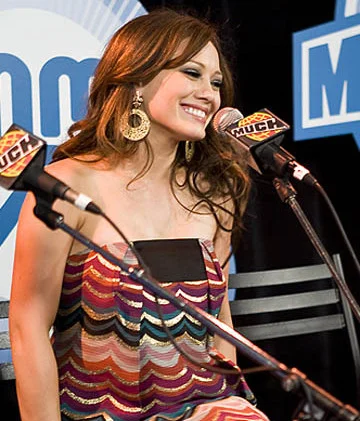
The second frame, from a music awards event in 2007, is the same era of press file: mid-2000s digital, harsh direct flash, and a three-quarter turn towards a bank of microphones. She is smiling and part of the upper arch is legible on the near side, foreshortened on the far side by the angle. Two low-resolution frames, two years apart, both flash-lit, both cropped from wider originals. That is the whole visual record available to this page.
What early digital press photography does to a face
Press cameras of that period had a characteristic signature and it is visible in both of these frames. Sensors were noisier, so files were processed with aggressive noise reduction that smooths low-contrast texture, and then with sharpening that adds bright halos along strong edges. On a face, the strongest edge available is usually the boundary between teeth and the dark interior of the mouth. That boundary is therefore the part of the picture most distorted by the processing.
Direct flash close to the lens compounds it. It removes modelling shadows, flattens the face and blows out the brightest highlights first. Enamel is glossy, so it produces specular highlights that clip to pure white in a small file long before the rest of the face is correctly exposed. A tooth that clips is a white shape with no internal detail, and a white shape with no internal detail cannot be assessed for shade, translucency or texture.
Chips, edges and shade in general terms
The general version of this query is what is normally done when the edge of a front tooth is chipped or when the shade of the front teeth is the concern. Written without reference to any named person, the answers are ordinary. A small chip or a worn corner can be rebuilt directly with tooth-coloured resin bonded to the remaining enamel, which is the least invasive option and is described on the composite bonding page. Where shade rather than shape is the issue, professional whitening lightens the existing tooth structure and changes nothing about its form. Where several front teeth need to be changed together in both form and colour, laminates bonded to the outer surface are one established approach; the E-max veneers in Turkey page explains what that involves, and the wider planning question of treating a smile as one unit rather than tooth by tooth is covered on the smile makeover page. Published figures sit on the dental prices in Turkey page.
None of these is being suggested for anyone named on this page. They are listed because the search term implies the question, not because the question has been answered here.
Nothing verified in her own words
No statement by Hilary Duff about her own teeth is quoted on this page. None could be verified to the standard set out in the sourcing policy before publication: the accounts in circulation are retellings of retellings, and this page does not launder that chain into a claim. She has never publicly confirmed any dental work in a source this page is prepared to cite, and no procedure of any kind is asserted or implied here. If a first-hand statement is published later, the page will be updated under the corrections policy.
Why archive files are a trap for comparison pieces
Comparison articles lean heavily on archives from the 2000s, because that is where the early frames are. The trap is that those archives are technically inconsistent in ways that reliably manufacture an apparent change. A 2007 press file and a 2020s digital frame differ in sensor, in noise handling, in sharpening, in colour science and in the amount of retouching applied before release. Place them side by side and the later image will almost always look brighter, sharper and more even — regardless of the subject.
The correct response is not to distrust photographs generally but to stop asking them a question they cannot answer. A photograph is a record of an exposure. It is evidence about a camera, a light and a moment, and it becomes evidence about a person only in the loosest sense.
Cover photo of Hilary Duff: The Heart Truth — Wikimedia Commons, public domain. The image is not evidence of any procedure.
In-article photo of Hilary Duff: Robin Wong — Wikimedia Commons, CC BY 2.5. Used under licence; the photographer does not endorse this page, and the image is not evidence of any procedure.
The section below describes general dentistry. It is background for the search term and is not a statement about Hilary Duff, whose dental history is not public.
Chipped edges and shade: what dentistry actually does
A chipped front tooth is one of the most common reasons people search for cosmetic dentistry, and the treatment ladder is short and well defined. The NHS sets out the usual sequence: a small chip may only need smoothing and polishing; a larger one is rebuilt with composite bonding or a filling; a fracture that reaches the pulp needs root canal treatment first, usually followed by a crown.
Cleveland Clinic adds a point that matters for anyone reading old photographs: a fragment of a broken tooth can sometimes be reattached rather than replaced, and small chips are frequently left untreated altogether. An edge that looks different between two images is therefore not evidence of a restoration — it may be wear, a chip that was polished, or simply a different angle.
Shade is the weaker signal still. Early digital press photography compressed heavily, and colour balance in those files drifted with the venue lighting rather than the subject. Comparing apparent tooth colour across archive frames from different years measures the cameras, not the teeth.
Back to the celebrity dental implants index · What dental implant treatment involves

Reach Us Now
Speak with our expert Istanbul Care Dental Group specialist. We're ready to answer your questions.