:no_upscale()/media/ic-dental/images/2026/03/2188bd29915a4501983011678565696c.webp)
:no_upscale()/media/ic-dental/images/2026/06/what-makes-a-smile.webp)


The Evolution of Tom Cruise's Smile
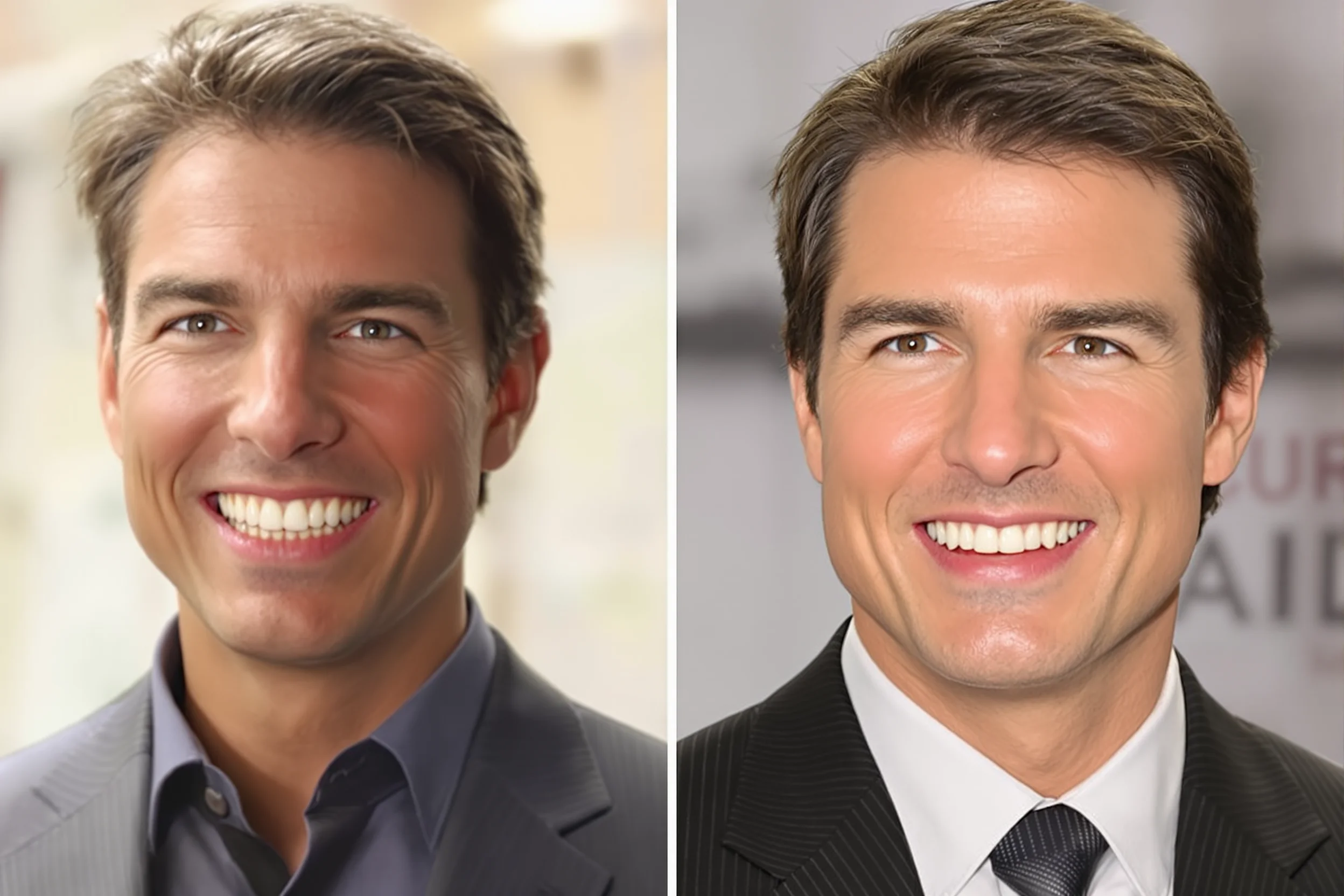
Early in his career, Tom Cruise's smile had noticeable quirks - a slight overlap on the front teeth, a gap between the upper centrals, and the off-centre middle tooth the internet later made famous. Fans still bring up that same photo from Risky Business and ask whether a smile like that can be fixed. The answer is yes, but Cruise's case is a good lesson in what modern dentistry can and can't erase. His midline was off, and dentists commenting publicly have suggested a lateral incisor may have been missing or undersized - the kind of detail that adds complexity.
By the mid-1990s, his smile started looking different. The gap was gone. The teeth appeared whiter and more even. Most dentists point to porcelain veneers as the main tool here, likely paired with a period of orthodontics to close the gap and align the bite. The missing lateral incisor was probably replaced with a bonded pontic or an implant later. The result? A strong, bright smile that still keeps a natural look - not the cookie-cutter Hollywood row you'd expect from full-mouth reconstructions. Some of the early veneers looked a touch bulky, but over the years the shape has softened.
Fast-forward to the 2010s, and his smile was almost flawless. The teeth appeared slightly shorter and more rounded - a sign the veneers were revised, probably with a more experienced cosmetic dentist. The slight asymmetry in the midline remained, which actually adds character. You can still see a hint of unevenness if you look closely. That's a deliberate choice: a completely symmetrical smile can look fake. Cruise's dentists kept a bit of human imperfection.
So what can you take away from the Tom Cruise teeth story? First, even Hollywood's most famous smile took years and multiple procedures to evolve. Second, correcting a missing lateral incisor isn't simple - a single implant with a custom abutment is the gold standard today, costing roughly £3,000-£5,000 in the UK. Third, veneers aren't a one-and-done deal. they need replacing every 10-15 years. Cruise's transformation shows the power of staged, incremental work rather than a single dramatic overhaul.
His case is a textbook example of how cosmetic dentistry can fix structural issues while keeping a natural feel. It's not about erasing every flaw - it's about building a believable smile that ages with you.
What Dental Work Did Tom Cruise Have?
You don't go from a slightly crooked, gapped smile in Risky Business to the blinding-white, perfectly aligned set he flashed in Jerry Maguire without serious dental intervention. Dentists who've studied the photos - and I've looked at enough myself - generally agree on a shortlist of procedures that transformed what we now call "tom cruise teeth."
Porcelain Veneers (Almost Certainly)
The workhorse of his makeover is porcelain veneers. Compare any early-80s shot to a mid-90s one: the shape, length, and colour change too drastically for simple whitening or bonding. Veneers are thin, custom shells that sit over the front of the tooth. Most dentists estimate he had six to eight upper teeth done - the ones visible when he talks. Each veneer costs anywhere from £600 to £1,100 in the UK (central London rates run higher). The procedure grinds down about 0.5 mm of enamel, takes two appointments, and lasts 10-15 years before requiring replacement. His current veneers aren't the first set. he's likely had them replaced at least once, probably around 2010.
Orthodontics to Fix the Midline
Look at a photo from Top Gun (1986). His upper midline - the gap between his two front teeth - doesn't line up with the centre of his nose. That's a midline shift. By 1996, it's gone. Standalone veneers can mask a small shift, but a misalignment that noticeable typically needs braces or clear aligners first. Some dental analysers point to Invisalign or traditional fixed braces in the late '80s or early '90s. He may have worn retainers for years afterwards. The orthodontic phase alone runs £3,000-£6,000 for a moderate case, and it would have been necessary before the veneers went on - otherwise, the veneers would sit on crooked teeth and the midline would remain off.
Bonding, a Crown, or an Implant?
He's had a lateral incisor - the tooth next to the right front tooth - that draws attention. In some 80s films the tooth looks shorter, even chipped. By the mid-'90s it matches the rest. That could be composite bonding (a tooth-coloured resin applied in one visit, £200-£400 per tooth) or a full porcelain crown if the tooth was structurally compromised. A handful of dentists also suggest a single-tooth implant on one lower incisor, based on a subtle shadow in high-definition side shots. Hard to confirm without an X‑ray, but the pattern fits a common story: a knocked-out tooth that got replaced with an implant and crown, adding about £2,500-£4,000 to the total bill.
Whitening - Maintenance, Not Transformation
His veneers are made to a specific shade (usually a bright A1 or B1 on the Vita scale). But natural teeth don't stay that colour without help. Between veneer replacements, he likely uses professional take-home whitening trays or in‑chair bleaching (Zoom, Philips) to keep the remaining natural teeth matching the porcelain. That's an annual or biannual spend of £300-£800 in the UK.
The 'Middle Tooth' and Facial Symmetry
Of all the quirks in Tom Cruise's pre-transformation smile, the most talked-about isn’t the colour or the chip - it’s the famous Tom Cruise middle tooth: a midline shift that made one front tooth appear to sit at the centre of his face. Look closely at a photo from the early 1980s and you'll see that the gap between his two front teeth doesn't line up with the centre of his face. That kind of misalignment is surprisingly common. Orthodontic studies have typically found that roughly one in four people have a dental midline that deviates enough to notice. In Cruise’s case the shift was pronounced enough to catch the eye even in a quick clip.
Facial symmetry is a strange thing. We don't consciously measure it, but we feel it. A perfectly aligned smile - where the line between the upper central incisors runs straight down the philtrum - reads as balanced, trustworthy. A skewed midline doesn't look 'wrong', but it does create a subtle tension. Orthodontists call it the 'midline discrepancy' and it's one of the first things they flag when a patient wants a Hollywood smile.
Tom's correction almost certainly happened in stages. First came braces - standard fixed metal brackets, probably for 12-18 months - to push the upper teeth into a centred position. Then veneers or composite bonding finessed the shape and width of each tooth so that the midline looked dead centre even if the roots underneath were still off by a hair. That's the real trick: you don't always need to move every tooth. Sometimes you widen one central incisor and narrow the other, and the eye sees symmetry even if the bone says otherwise.
For someone reading this, wondering what it would cost to fix their own midline: expect a consultation around £80-£150 in a London clinic, and treatment anywhere from £2,500 for a simple composite recontouring to £6,000-£10,000 if you need Invisalign and veneers together. Tom Cruise's teeth journey shows that even a visible midline shift can be handled without years of headgear - just smart planning and a bit of cosmetic artistry.
The end result isn't a perfect, artificial line.
Celebrity Smile Secrets: The 2-2-2 Rule
Dentists who study the smiles of A-listers often point to what they call the 2-2-2 rule. It's a shorthand for the six front teeth that frame every big grin: the two central incisors, the two lateral incisors, and the two canines. In Tom Cruise's case, those six teeth underwent a massive shift from his early roles to where they are today. The rule matters because if those six aren't in line - in angle, colour, shape, and proportion - no amount of whitening or gum contouring will fix the overall look.
When Cruise first appeared on screen, his central incisors were rotated and his midline was noticeably off. That throws the entire 2-2-2 grouping out of whack. His orthodontic work and later veneers essentially rebuilt those six units. The central incisors were widened slightly to fill the smile, the laterals were reshaped to match a 78% width ratio (a common cosmetic target), and the canines were softened at the tips so they didn't dominate. That exact alignment is the hallmark of the 2-2-2 rule in practice.
What you can take from it
If you're looking at your own smile and wondering where to start, look at those six teeth. A dentist will check three things:
- Symmetry - the centre line between your top two incisors should align with the bridge of your nose.
- Proportions - the width of each tooth relative to its neighbour. The central incisor should be about 1.6 times wider than the lateral incisor beside it.
- Edge alignment - the biting edges should form a gentle curve that mirrors your lower lip.
In Tom Cruise's transformation, work on these six teeth created the entire effect. For most people, correcting just those six - through bonding, veneers, or minor ortho - costs a third of what a full-mouth rebuild would run. The 2-2-2 rule isn't a marketing gimmick.
How Much Would a Tom Cruise Smile Cost in the UK?
Straight answer if you're shopping for a Tom Cruise-style result in the UK: expect somewhere between £600 and £1,200 per tooth for porcelain veneers. Tom Cruise himself had a full set - upper and lower - which means around 20 teeth. That puts a direct replica at roughly £12,000 to £24,000 for the veneers alone. Most UK clinics don't charge a flat "smile makeover" fee. they price per unit.
But veneers are rarely the only cost. Cruise also straightened his teeth first. In the UK, six-month clear aligner treatment runs £2,000 to £4,500, depending on complexity and clinic location. London practices typicaly push toward the higher end. Add a professional whitening session - £350 to £700 - and you're looking at a total bill between £15,000 and £30,000 by the time you walk out.
Few clinics offer a single "Tom Cruise package". Instead, they'll split the work: consultation, digital smile design, temporary veneers, then the final ceramic set. Consultation fees alone can be £100 to £250, and many clinics deduct that from the final cost if you proceed. Don't skip the digital preview - it costs extra (£200-£500) but saves heartache later.
If you want the exact shade and shape Cruise had - bright, straight, slightly squared incisors - expect the upper end. The materials matter too. Emax pressed ceramic is the gold standard. it's stronger and more translucent than older feldspathic types. That adds maybe £100-£200 per tooth over the baseline.
Finance options exist. Many clinics offer 0% APR over 12-24 months through third-party lenders, so you can spread £18K without interest. Just check the small print - some charge setup fees.
One more thing.