:no_upscale()/media/ic-dental/images/2026/03/2188bd29915a4501983011678565696c.webp)
:no_upscale()/media/ic-dental/images/2026/08/cardi-b-teeth-cover-istanbul-care-dental.webp)
Cardi B Teeth: What the Public Photographs Show
Cardi B Teeth: What the Public Photographs Show
Editorial note. Istanbul Care Dental has not treated Cardi B and has no access to any dental records. Nothing on this page states or implies that Cardi B has had a veneer, a crown, whitening or any other dental treatment. The photograph below is a licensed image that identifies the person only; it is not before-and-after evidence, and the photographer does not endorse this page.
Cardi B teeth: what one licensed photograph actually shows
The image on this page was taken on 3 July 2026 at a music festival in New Orleans. It is a close frontal portrait made at an event rather than in a studio: the subject is facing the camera with both arms raised, the background is a plain dark purple, and the light comes from close to the camera position.
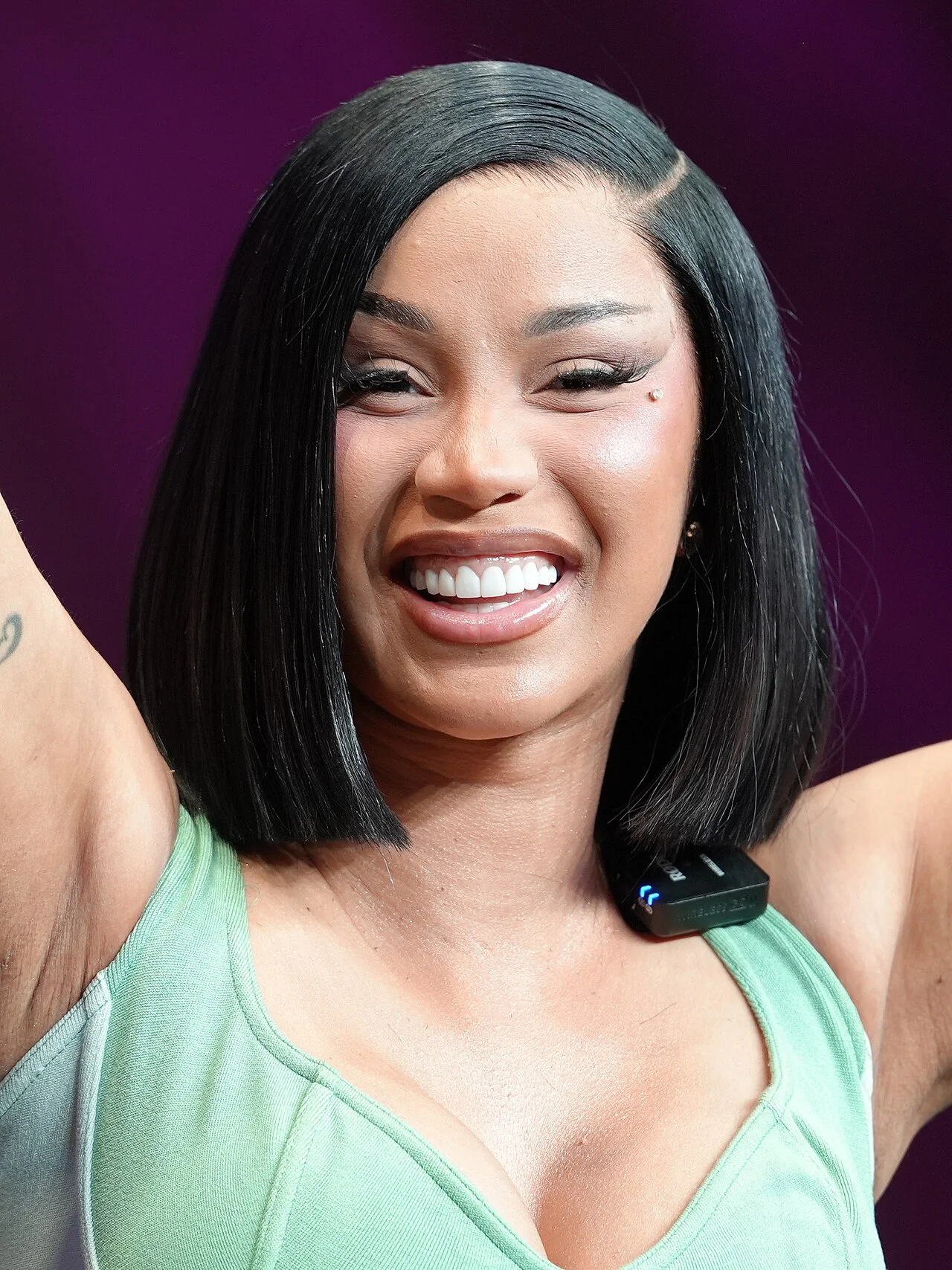
This is the most informative frame on the whole of this section of the site, and it is still a limited one. The smile is wide and open, and the upper front teeth are visible from roughly canine to canine, with the edges of the lower teeth showing below. The frontal angle means the two central incisors are recorded close to straight on, which is the one condition under which a photograph can say something about the relationship between the dental midline and the midline of the face without much distortion.
Everything else is still compromised, and mostly by the light. The illumination is frontal and hard, which is what event photographers use, and hard frontal light does three things at once: it removes the shadows that convey shape, it maximises brightness on any pale surface, and it places a specular highlight on every wet curved surface in the frame. The bright spots on the front teeth here are reflections of the light source, and glossy lip product beside them reflects in the same way. A photograph made under these conditions will always render teeth brighter and flatter than they appear in a room.
What this page does not claim
This page does not claim that Cardi B has had dental treatment, and it does not claim that she has not. No first-hand statement by her about her teeth is quoted, because none could be verified to the standard set out in the sourcing policy before publication. That gap is reported rather than closed with an assumption.
It is worth restating the boundary in plain terms, because this genre of writing routinely crosses it. Describing what is visible in a dated, licensed photograph is reporting. Naming a procedure on the basis of that photograph is not reporting; it is invention with a photograph attached.
Why flash photography flatters everything pale
Direct flash is the default at red carpets, festivals and press lines, because it is fast, portable and produces a usable exposure regardless of the ambient light. It is also close to the worst possible light for judging a tooth, for reasons that are entirely ordinary.
The first is intensity falloff. Light from a small source close to the camera falls off sharply with distance, so a face two metres away is lit far more brightly than a background five metres behind it. Photographers expose for the face, and that pushes the brightest parts of the face towards the top of the sensor's range. When a bright area approaches that limit, differences within it compress: two slightly different shades of white record as the same white.
The second is specularity. Enamel is smooth, curved and covered by a film of saliva. A small hard light source produces a mirror-like reflection on each such surface, and those reflections are images of the flash, not properties of the tooth.
The third is colour. Flash tubes are close to daylight balance, while stage and venue lighting is usually much warmer. When both reach the subject, the resulting mixture is not a colour the camera can balance correctly for every part of the frame, and the correction applied to the skin is applied to the teeth as a side effect.
None of this means press photographs are worthless. It means they are good evidence about expression and poor evidence about shade, texture and material.
The general dentistry behind the search term
Described generally, and attached to no named person, the relevant treatments split cleanly by how much tooth structure they involve.
The least invasive is colour work. Professional whitening lightens existing tooth structure and removes nothing; a hygiene appointment removes surface staining and hard deposits, and the visible change from that step alone is often underestimated. Next is additive work: composite bonding rebuilds chipped edges or closes small gaps with resin placed directly onto the tooth, and can normally be adjusted later.
Beyond that, the work becomes permanent. E-max veneers are thin ceramic facings bonded to prepared front surfaces, and zirconium crowns cover a tooth completely where too little structure remains for a facing. Where a full front-of-mouth plan is involved, the sequence is usually organised as a smile design, which starts with gum health, bite and proportion rather than with ceramic shade. The clinic's published figures for all of these are on the dental prices in Turkey page, and nothing in this section describes treatment given to anyone named on this page.
How to read celebrity smile coverage
The recurring format is two photographs, an asserted difference and a named procedure. It is unsound at every step: the photographs differ in equipment, light and processing before they differ in content; a difference that survives those variables may still be caused by ageing, wear, staining or lipstick; and naming a cause requires information no photograph contains. A photograph is evidence about a photograph. A verified first-hand statement is evidence about a person. This page holds that line.
Photograph of Cardi B: Runawaymo — Wikimedia Commons, CC BY-SA 4.0. Used under licence; the photographer does not endorse this page, and the image is not evidence of any dental procedure.
Back to the celebrity dental implants index · What dental implant treatment involves · Editorial policy

Reach Us Now
Speak with our expert Istanbul Care Dental Group specialist. We're ready to answer your questions.