:no_upscale()/media/ic-dental/images/2026/03/2188bd29915a4501983011678565696c.webp)
:no_upscale()/media/ic-dental/images/2026/06/Tooth-Bridge-Types-Costs-Lifespan-Clinical-Overview.webp)


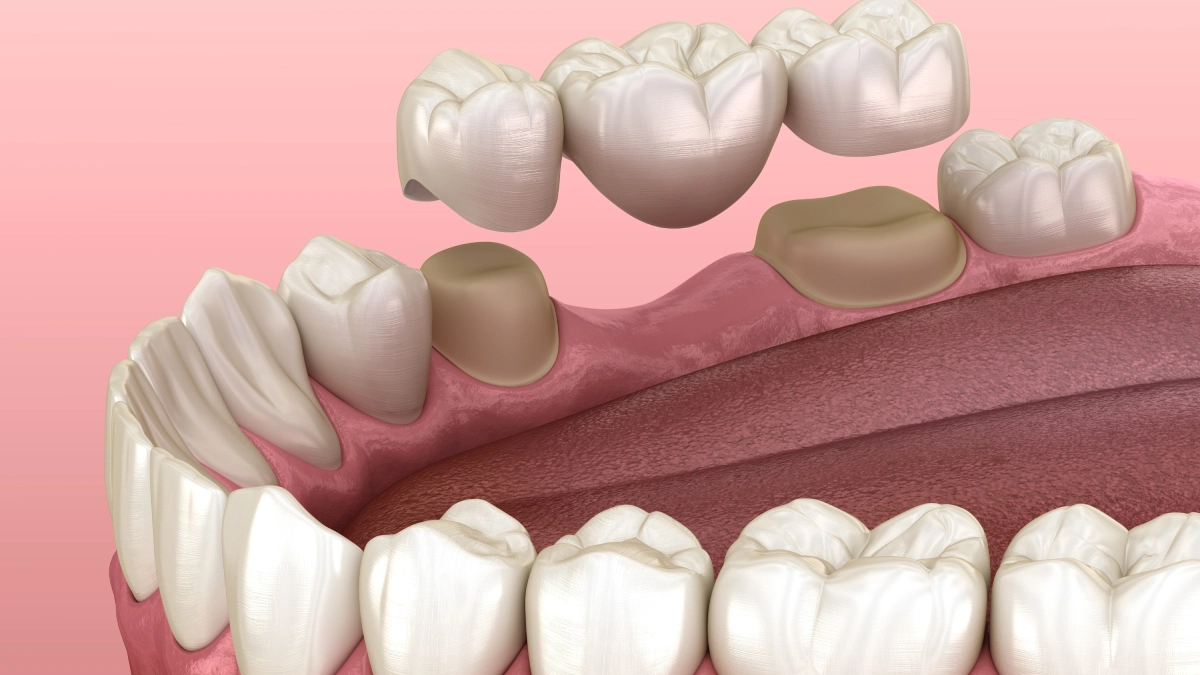
What Is a Tooth Bridge?
Look, a dental bridge fills the gap left by a missing tooth.
You've got a missing tooth, and the space needs filling.
One or more false teeth are anchored to the neighboring teeth.
That's basically how it works.
In reality, cemented onto your existing teeth, not sitting on the gum like an implant.
A fixed appliance, basically, and it doesn't come out at night.
Stays put.
Each end caps a natural tooth like a crown.
The pontic (the fake tooth)sits in the gap between them.
Years with a gap.
Around two visits.
Full smile.
Three to four weeks.
That's the whole timeline.
Honestly, so why bother? It does more than look bad.
A missing tooth shifts your bite, causing additional issues.
The teeth around it start leaning. The opposite one drifts down.
Truth is, about 15% of adults 35-44 have a missing tooth.
A bridge is often the least invasive fix.
An implant means surgery. A bridge does not.
And the cost?
When you're looking at getting a dental bridge, the cost will land somewhere between $1,500 and $6,000 depending on the material you pick and the clinic's location.
It's wide but gives a ballpark.
Different types of dental bridges matter, and each one - traditional, cantilever, Maryland, bridge implant (implant-supported) - has a different setup.
For a traditional bridge, you need crowns on both supporting teeth.
Cantilever uses one adjacent tooth only.
The Maryland bonded bridge uses a metal or porcelain wing instead of crowns.
That one is more common for front teeth where chewing force is lower.
If you keep the hygiene solid, most hold up 10 to 15 years. Forever? No. In practice, but a decade of working teeth without going under the knife? A lot of people take that deal.
Dental Bridge vs. Implant: Clinical Decision-Making
I've sat across from dozens of patients staring at the plan, trying to pick a direction. They often have questions. It's never a simple call.
Both a dental bridge and a individual implant replace a missing tooth. And that's where the similarity stops. Three things drive the clinical call, and you can't fudge any of them: the neighboring teeth's health, bone volume in the gap, and the patient's schedule.
Speed-wise, bridge procedure: two appointments.
Maybe three weeks total.
Abutment teeth get shaved down. Permanent change.
Crowns set. Bridge locked in.
Good hygiene can push a bridge's life to 12 or 15 years.
Truth is, downside? Now those two healthy teeth carry the load for the missing third.
Bite dynamics shift.
Over time, the abutments can drift, and decay creeps in right where the crown meets the gumline if flossing is sloppy.
Implants take longer.
About four to six months from beginning to end, sometimes longer if bone grafting is needed first.
But you're not touching the adjacent teeth. That alone is a massive advantage.
The catch? It costs more.
Cost without insurance, a single implant in the US, after all costs, runs $3,000 to $6,000.
Three-unit bridges typically fall between $1,500 and $4,000.
Does dental insurance cover these costs?
Insurance caps change the numbers once they come into play.
If the neighboring teeth are pristine-no fillings, no cracks-I lean toward implants.
Why grind down two healthy surfaces if you can avoid it?
But if the abutments already have crowns or large fillings, a bridge is the practical choice.
No virgin enamel sacrificed, and you're using what's already there.
There's also the bone question. If the ridge is thin - say, less than 4mm - the graft needed for an implant adds cost and recovery time. Some patients just don't want to deal with that. Honestly, a bridge bypasses the problem entirely.
Age matters too. A 75-year-old with other health concerns might prefer the shorter, less invasive bridge route. A 40-year-old who's still got decades of chewing ahead, and an implant usually pencils out better in the long run.
Honestly, neither option is wrong. Biology plus the person, match them to the approach that fits. Most guides skip that part, the decision-making.
Cost of Dental Bridges: Insurance and Out-of-Pocket Expenses
Now, about costs.
Look, a single tooth bridge in the US?
Between $1,500 and $6,500 per tooth. That's the wide range.
Why the spread?
Material matters, a basic porcelain-fused-to-metal bridge sits at the lower end, while zirconia or all-ceramic materials can push the cost toward the ceiling.
Location matters.
Fees for a Manhattan dentist differ from rural Ohio.
The number of anchor teeth also matters: a three-unit bridge costs less than a four-unit.
How Insurance Treats Bridges
Truth is, most dental insurance plans call bridgework 'major care', and translation: they chip in, but not lavishly.
A typical plan covers 50% after the annual deductible-usually $50-$100.
In reality, some plans impose a 6-to-12-month waiting period before paying a dime.
Last month, a patient walked in thinking his PPO covered 80%.
It covered fifty.
Look (look)he had to scramble.
Always check whether your plan has an annual cap too, often $1,500-$2,000 total for all major procedures.
That cap can vanish fast on a single bridge.
What Medicare and Medicaid Cover
Truth is, original Medicare (Parts An and B) doesn't cover dental bridges.
Period.
In reality, if you're over 65 and on Medicare, out-of-pocket is your only bet unless you've got a separate Medicare Advantage plan with a dental rider.
Medicaid varies by state: some cover bridges fully for low-income adults (others only for children)some offer nothing at all.
In practice, call your state's Medicaid office and drop the phrase 'prosthodontic benefits for adults', that's your safest bet.
That phrase right there.
Getting a Grip on Out-of-Pocket Costs
Look (no insurance)no discount, you pay full price.
Some dentists offer in-house payment plans.
Others partner with outside lenders like CareCredit.
Absolutely worth asking.
There's another path: dental schools.
What's the trade-off?
Multiple appointments.
Slower turnaround, too.
Have an FSA or HSA?
That money covers bridges tax-free.
Honestly, use them.
Honestly, the smartest move, and get a written treatment plan with itemized costs before committing. That's the only way to know what your insurance actually leaves you holding. Ask for the CDT codes. Your insurer can then give you the exact estimate.
Longevity and Maintenance of Dental Bridges
Most patients assume a dental bridge will last forever.
It's optimistic.
In reality, the typical lifespan falls between 5 and 15 years, with 10 years being the average before some kind of repair or replacement is needed.
The rest? They started skipping steps around year four.
What kills a bridge early is almost always the teeth supporting it. Decay under the crown, gum disease around the abutment, or bone loss from poor hygiene. The bridge itself doesn't rot - the structure underneath does. If the supporting tooth fails, the whole thing has to come off. That one's no quick fix. New bridge, new impressions, and a new cost to go with it.
Daily cleaning trips most people up, and brushing alone won't cut it. Honestly (under a bridge)there's a gap where food packs in. Flossing a bridge? You'll need a threader or a water flosser aimed right at the gumline. Honestly, patients hear this: picture the space under the false tooth as a pocket that needs clearing every single night. Skip three days, and the gum starts swelling. Skip it for three weeks and you're looking at early-stage decay on the abutment tooth. Waterpik makes a model with a bridge tip that works well.
Cocofloss or GumChucks also help reach the tricky spots.
Professional maintenance matters just as much. In reality, you need exams every six months where the dentist checks the margins - the edge where crown meets tooth - for any gap or roughness. X-rays every 12 to 18 months catch decay before it reaches the nerve. A loose bridge should never be ignored. If it rocks even slightly, the cement seal is broken and bacteria are already working underneath. In practice, catch it early and tightening costs a fraction of what you'd pay for a full rebuild later.
Hard foods? Avoid them. Sticky foods too. Ice, hard candy, caramel, even crusty bread, they all stress the bridge or loosen the cement. Night grinding? Silent killer. Nightguard?
Honestly, cheaper than a replacement.
One acrylic guard. Adds years.
Chew on one side only? Uneven wear.
Procedure and Pain Management for Dental Bridges
Turns out (a tooth bridge takes two visits)spaced about two weeks apart. The first appointment involves numbing the area with local anesthetic - that shot in the gum is the worst part, honestly. Your dentist trims down the abutment teeth (takes impressions)and fits a temporary bridge. Honestly (no pain during the drilling)but you might feel some pressure. I've had patients tell me the temporary feels weird, not painful. There's more detail in our guide to a silver tooth cap.
Once the permanent bridge is cemented (second visit), expect mild soreness for a day or two. Over-the-counter ibuprofen handles it fine. Truth is, some people get temperature sensitivity - that disappears within a week. Honestly, the gum under the pontic may feel tender if food packs in. In practice, a saltwater rinse helps, and recovery is quick: most chew normally within 1-2 weeks. The tooth bridge should feel stable, not loose. If it hurts when you bite, that means the fit needs a small adjustment - a common fix your dentist can do in minutes.